`
Tara Capital Investment Framework

TCIF — Weekly Regime Assessment

🟡 Mid-Cycle Growth · LOW confidence
56.1
composite score / 100

The TCIF reads seven macroeconomic signal categories every week to determine the prevailing market regime — and where conditions sit in the cycle.

Category Breakdown

Liquidity 48

Global central bank balance sheet momentum, M2 growth, and cross-border capital flow conditions.

Real Yields 56

Inflation-adjusted Treasury yields (TIPS), with emphasis on 10y real rate direction and level.

Dollar 60

DXY trend and momentum; dollar strength compresses global liquidity and risk appetite.

Credit Conditions 56

Investment-grade and high-yield spread levels, credit impulse, and lending standards.

Growth Indicators 56

US payrolls, industrial production, unemployment, the Chicago Fed National Activity Index, Empire State manufacturing survey, durable goods orders, and copper/gold and equity momentum.

Financial Conditions 83

NFCI / ANFCI composite — a broad gauge of tightness or looseness in the US financial system.

Inflation 52

AI CapEx 46

AI infrastructure investment flow, hyperscaler capex trajectory, and semiconductor demand signals.

This Week's Read

The framework is reading 56/100 — the environment is balanced and sustainable, with no dominant stress signal. Financial Conditions is the standout tailwind at 83, with NFCI -0.55 (very loose). 3 of 8 categories are on improving trajectories, giving the composite a positive short-term bias. The key watch-point is whether Real Yields continue rising — that is the variable most likely to break the current equilibrium.

New to the TCIF? Read the full framework explainer — how we define regimes, what each category measures, and how the score maps to allocation positioning.

Read the Framework

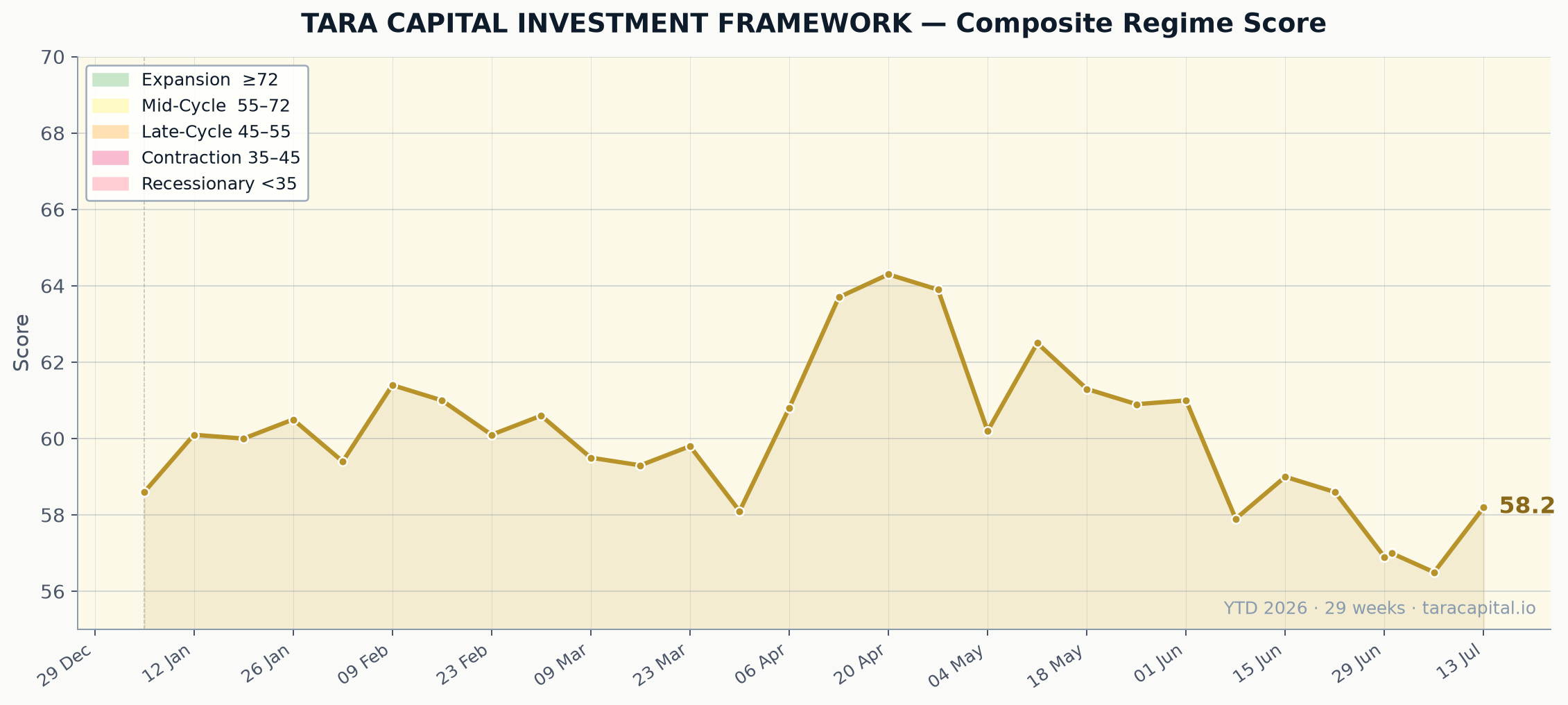
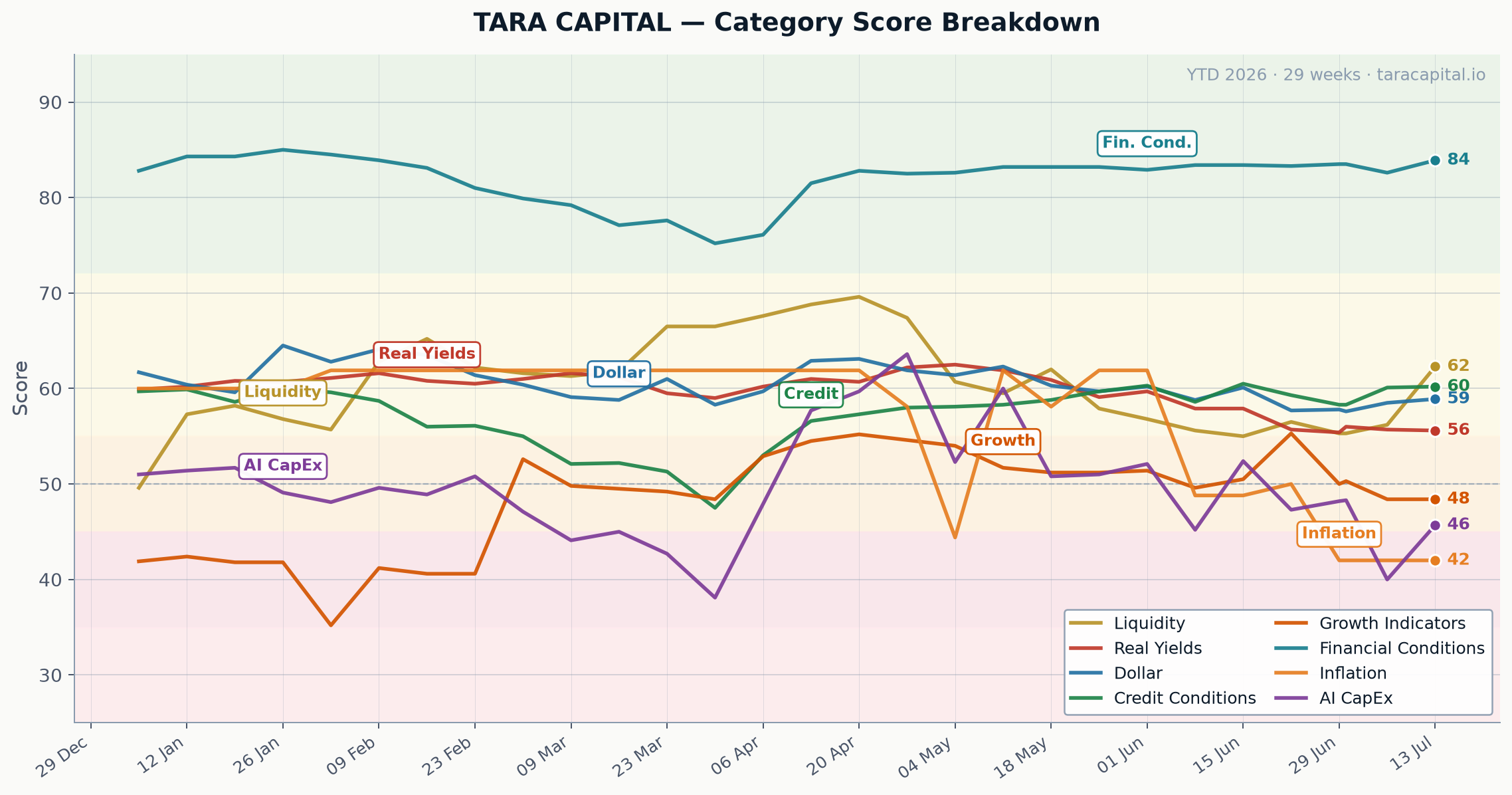
YTD Charts

Year-to-date composite regime score and category breakdown — updated every Monday.

TCIF — Composite Regime Score (YTD)

TCIF — Composite Regime Score (YTD)

TCIF — Category Scores (YTD)

TCIF — Category Scores (YTD)

Sector Positioning

Positioning as at 3 August 2026 — derived from the eight-category regime score above.

Sector Allocation — Mid-Cycle Growth

Composite 56.1/100 · TCIF Eight-Category Framework

Sector Signal Rationale
Energy — Neutral Energy neutral — inflation moderating, growth signal insufficient to confirm demand-pull commodity bid.
Materials — Neutral Materials neutral — mixed inflation and dollar signals; no directional conviction.
Industrials ● OW Industrials constructive; mid-cycle capex and credit conditions support earnings.
Consumer Discretionary ● OW Discretionary constructive on solid growth and liquidity backdrop; inflation not yet a headwind.
Consumer Staples ● UW Staples underperform in expansion — opportunity cost of defensives high when risk-on is running.
Health Care — Neutral Health Care neutral — neither the growth rotation nor defensive rotation is dominant here.
Financials ● OW Financials constructive on loose liquidity and credit backdrop; yield curve supportive.
Information Technology ●● OW Tech leads in goldilocks regime — moderate inflation keeps real yields in check; AI CapEx supports.

Key macro themes:

  • Loose financial conditions support broad risk appetite — quality growth preferred

Strong OW: Information Technology. Also OW: Industrials, Consumer Discretionary, Financials. UW: Consumer Staples.

Implementation Signals

Vehicles in the universe aligned with current regime positioning — as at 3 August 2026. These are macro-driven signals, not buy/sell recommendations. Valuation, sizing, and risk management remain separate judgements.

Ticker Name Type Driver Signal Direction Rationale
NVDA NVIDIA Corporation EQUITY Sector: Information Technology Strong OW Strong OW Consider adding Regime supports quality growth; AI capex cycle and financial conditions favour IT.
AMD Advanced Micro Devices EQUITY Sector: Information Technology Strong OW Strong OW Consider adding Regime supports quality growth; AI capex cycle and financial conditions favour IT.
MSFT Microsoft Corporation EQUITY Sector: Information Technology Strong OW Strong OW Consider adding Regime supports quality growth; AI capex cycle and financial conditions favour IT.
PLTR Palantir Technologies Inc. EQUITY Sector: Information Technology Strong OW Strong OW Consider adding Regime supports quality growth; AI capex cycle and financial conditions favour IT.
AVGO Broadcom Inc. EQUITY Sector: Information Technology Strong OW Strong OW Consider adding Regime supports quality growth; AI capex cycle and financial conditions favour IT.
SOXX iShares Semiconductor ETF ETF Sector: Information Technology Strong OW Strong OW Consider adding Regime supports quality growth; AI capex cycle and financial conditions favour IT.
MU Micron Technology Inc. EQUITY Sector: Information Technology Strong OW Strong OW Consider adding Regime supports quality growth; AI capex cycle and financial conditions favour IT.
ORCL Oracle Corporation EQUITY Sector: Information Technology Strong OW Strong OW Consider adding Regime supports quality growth; AI capex cycle and financial conditions favour IT.
MRVL Marvell Technology Inc. EQUITY Sector: Information Technology Strong OW Strong OW Consider adding Regime supports quality growth; AI capex cycle and financial conditions favour IT.
TXN Texas Instruments Incorporated EQUITY Sector: Information Technology Strong OW Strong OW Consider adding Regime supports quality growth; AI capex cycle and financial conditions favour IT.
INTC Intel Corporation EQUITY Sector: Information Technology Strong OW Strong OW Consider adding Regime supports quality growth; AI capex cycle and financial conditions favour IT.
QCOM Qualcomm Incorporated EQUITY Sector: Information Technology Strong OW Strong OW Consider adding Regime supports quality growth; AI capex cycle and financial conditions favour IT.
PG Procter & Gamble Co (NYSE) EQUITY Sector: Consumer Staples UW UW Consider reducing Risk-on expansion regime reduces defensive premium for staples.
KO The Coca-Cola Company (NYSE) EQUITY Sector: Consumer Staples UW UW Consider reducing Risk-on expansion regime reduces defensive premium for staples.
ULVR.L Unilever PLC (LSE) EQUITY Sector: Consumer Staples UW UW Consider reducing Risk-on expansion regime reduces defensive premium for staples.
BATS.L British American Tobacco PLC (LSE) EQUITY Sector: Consumer Staples UW UW Consider reducing Risk-on expansion regime reduces defensive premium for staples.
DGE.L Diageo PLC (LSE) EQUITY Sector: Consumer Staples UW UW Consider reducing Risk-on expansion regime reduces defensive premium for staples.
RKT.L Reckitt Benckiser Group PLC (LSE) EQUITY Sector: Consumer Staples UW UW Consider reducing Risk-on expansion regime reduces defensive premium for staples.
IUCS.L iShares S&P 500 Consumer Staples Sector UCITS ETF ETF Sector: Consumer Staples UW UW Consider reducing Risk-on expansion regime reduces defensive premium for staples.
XDWS.L Xtrackers MSCI World Consumer Staples UCITS ETF ETF Sector: Consumer Staples UW UW Consider reducing Risk-on expansion regime reduces defensive premium for staples.

Signals derived from sector rotation (OW/UW), country engine, and theme alignment. Access category A/B vehicles only shown. “Consider adding” = macro backdrop supportive. “Consider reducing” = macro backdrop deteriorating.

The TCIF is a macro analytical framework, not investment advice. Signals indicate regime alignment only. All investment decisions — including whether to act on any signal shown here — require independent judgement on valuation, portfolio construction, and risk. Past regime signals are not indicative of future performance.

Clayton Gillece

Founder, Tara Capital

Still curious. Still learning. Still having fun.

All TCIF Reports